
Conrad Atkinson

Born 1940, West Cumbria, England
Conceptual Artist - Cultural Activist - Professor Emeritus
Biography
Conrad Atkinson is one of Britain’s most pioneering contemporary conceptual artists, renowned for fusing political activism with visual practice. Across a career spanning over eight decades, Atkinson has continually challenged how art intersects with socio-political power, human suffering, and institutional authority.
Early Life & Education
Born in West Cumbria in 1940, Atkinson’s working-class background in an industrial region shaped his life-long artistic focus on labour issues, environmental policy, and social justice. He formally trained at:
Carlisle College of Art
Liverpool College of Art
The Royal Academy of Arts, London
Activism and Art Practice
Beginning in the early 1970s, Atkinson forged new strategies to subvert traditional art spaces. His early practice mimicked the tools of political activism, employing documentary photographs, strike posters, archival text, collage, and found "evidence." His seminal works from this era directly engaged with local and global human rights issues, including industrial lung diseases (such as pneumoconiosis and mesothelioma), the British asbestos scandal, and the thalidomide tragedy.
During the Troubles in Northern Ireland, Atkinson created critical, activist-driven projects that faced institutional censorship in the 1970s. Decades later, in 2007, he returned to Belfast for a major commission by the Belfast Media Group, exhibiting Some Wounds Healing; Some Birds Singing at the Grand Opera House.
Academic Career & Collections
Atkinson has held distinguished academic and advisory positions in both the United Kingdom and the United States:
-
Professor Emeritus of Art and Art History at the University of California, Davis.
-
Distinguished Visiting Professor at the Courtauld Institute of Art (2002).
-
Winston Churchill Fellow and Honorary Fellow at the University of Cumbria.
His work is represented in major public and museum collections globally:
-
The Tate Gallery, London
-
The Museum of Modern Art (MoMA), New York
-
The British Museum, London
-
National Gallery of Australia, Canberra
-
National Portrait Gallery, London
-
MIMA, Middlesbrough
-
The Castle, Nottingham


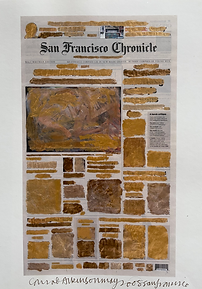
The Newspaper Series: Initiated in the 1980s, Atkinson created modified newspaper and magazine front pages using satire and subversion to question how power dictates narrative. Publications including The Guardian and Art in America subsequently commissioned original front-page projects from him.

Romanticism and Ecology: Combining satire with visual poetry, Atkinson's later works frequently referenced art history, literature, and radical Romantic traditions, such as the works of William Wordsworth, exploring human intervention in natural landscapes.


Anti-Landmine Campaign: Serving as the official artist for the U.S. Campaign to Ban Landmines (Vietnam Veterans Trust), Atkinson created provocative fine-art objects. Among his most notable pieces was a series of delicate porcelain landmines slip-cast in the shape of Valmara 69 anti-personnel bombs—decorated with in-glaze transfers of Princess Diana visiting Angola in 1997, juxtaposed with gold detailing and ironies of consumer culture.


Political Portraits: Throughout his career, Atkinson produced striking portraits- ranging from affectionate to sharply critical-of figures such as Ronald Reagan, George W. Bush, Gerry Adams, and William Wordsworth.


